The Rise of Agentic AI: Your Next Coworker Might Not Be Human

The Rise of Agentic AI: Your Next Coworker Might Not Be Human
April 2026 | Technology & Innovation
Not long ago, artificial intelligence meant a chatbot that answered your questions and occasionally hallucinated a wrong answer. You typed something in, it typed something back. That was the deal. Simple, transactional, and ultimately quite limited.
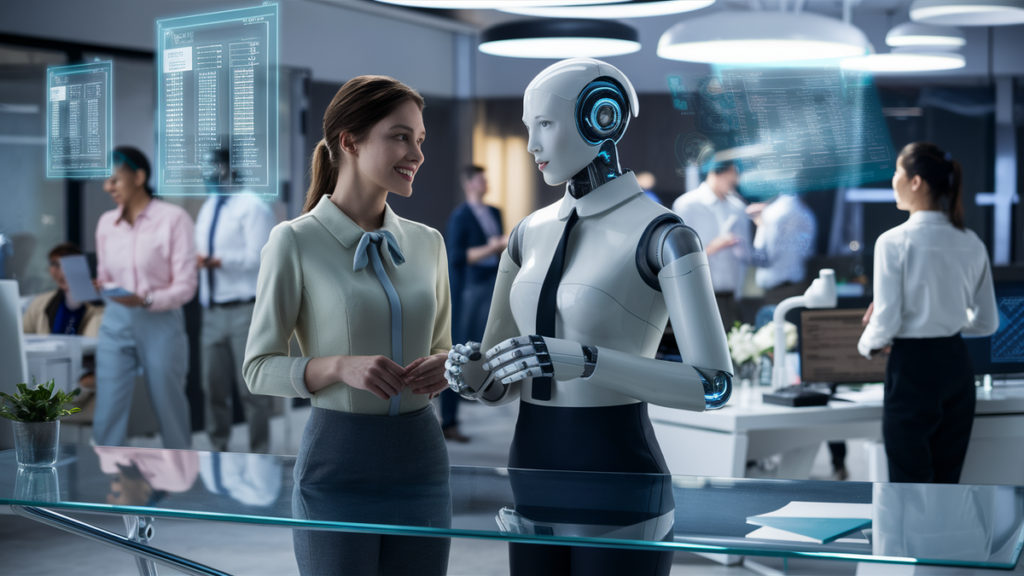
In 2026, that version of AI feels almost quaint.
Welcome to the age of Agentic AI — systems that don’t just respond to prompts but actually do things. They plan, decide, take actions across multiple platforms, loop back and correct themselves, and accomplish complex goals with minimal hand-holding. The shift is less like upgrading your smartphone and more like hiring an employee — one who works at machine speed, doesn’t sleep, and can manage a dozen workflows simultaneously.
This isn’t hype. It’s already happening inside offices, hospitals, banks, and software companies around the world, and the numbers tell a striking story.
From Assistant to Agent: What Changed?
Think about how you use AI today. You ask it to write a draft, generate an image, or summarize a document. Each interaction is self-contained — you prompt, it responds, conversation over.
Agentic AI breaks that loop entirely.
Rather than answering questions, AI agents understand a goal, create a plan, and execute multi-step tasks across different applications — all under human oversight. This represents a fundamental leap from an “add-on” approach to an “AI-first” process. We are, in a very real sense, moving from telling computers how to do something, to simply telling them what we want — and letting them figure out the rest. Gappsgroup
An intelligent agent is becoming more autonomous, managing complex workflows without needing constant human oversight. Agentic AI is reshaping the state of AI faster than anyone predicted. SS&C Blue Prism
A practical example: instead of you logging into five different tools to compile a weekly sales report, an AI agent connects to your CRM, pulls the data, runs the analysis, writes the summary, and drops it in your inbox — every Monday morning, automatically. No prompt required.
The Numbers Are Staggering
The scale of adoption underway right now is unlike anything seen in enterprise technology for decades.
Gartner predicts that 40% of enterprise applications will embed AI agents by the end of 2026, up from less than 5% in 2025. That’s an eightfold increase in a single year. The autonomous agents market size reached $5.83 billion in 2026, up from $4.42 billion in 2025, and the global AI agents market is projected to grow to $12.06 billion in 2026, marking a strong year-over-year increase. MachineLearningMasterySQ Magazine
Nearly 85% of executives believe employees will rely on AI agent recommendations to make real-time, data-driven decisions by 2026. Salesmate
These aren’t projections from tech optimists in Silicon Valley boardrooms. They reflect genuine deployment decisions being made by CIOs and operations leaders who have moved well past the “pilot project” phase.

Multi-Agent Systems: The Digital Assembly Line
One of the most fascinating developments in agentic AI is the emergence of multi-agent systems — not just one AI agent working on a task, but several specialized agents collaborating in sequence, like departments within a company.
In 2026, business value grows by creating “digital assembly lines”: human-guided, multi-step workflows where multiple agents run a process from start to finish. This is made possible by the Model Context Protocol (MCP), a standard that allows agents to connect seamlessly with diverse data sources and take real-time actions. Gappsgroup
Imagine a marketing team’s entire weekly content operation running through four coordinated agents: one monitors trends and competitor activity, another drafts social posts in the brand’s specific voice, a third generates accompanying visuals, and a fourth pulls campaign performance data and writes the analysis. The humans set the strategy and approve the outputs. The agents handle the execution.
Multi-agent systems deliver 3x higher ROI according to McKinsey — and the trend is moving toward multi-agent orchestration, with specialized agents collaborating like departments within a company. Chatarmin
The Human-in-the-Loop: Not Optional, But Essential
One thing the most thoughtful AI leaders are quick to stress is that agentic systems are not replacing human judgment — they’re amplifying it. The most successful implementations in 2026 follow what practitioners call a “human-in-the-loop” model.
Perhaps the most valuable capability development in 2026 is agents learning when to ask for help, rather than blindly attempting every task, and humans stepping into the loop only when required. Anthropic
For business-critical workflows — high-value refunds, contract questions, escalations — a human approves the process. The AI prepares autonomously, the human decides. That’s not a step backward — it’s the difference between a pilot project and a system that runs in production. Chatarmin
This nuance matters enormously. The goal is not autonomous AI running amok — it’s AI that handles the repetitive, high-volume, well-defined work, while humans focus on judgment calls, strategy, and relationships. The best analogy is a pilot and co-pilot: both are in the cockpit, but the division of labour is clear.
Agentic AI in the Real World
The industries seeing the most dramatic transformations are software development, finance, customer service, and cybersecurity.
In software engineering, coding agents are already writing full feature sets and handling testing cycles. By 2026, agents are working for days at a time, building entire applications and systems with minimal human intervention, with humans focused on providing strategic oversight at key decision points. Anthropic
In cybersecurity, the stakes are especially high. An Agentic Security Operations Center (SOC) uses a system of task-based agents to move from simply flagging alerts to actively investigating, analyzing malware, and recommending responses in real time — elevating human analysts from tactical responders to strategic defenders. Gappsgroup
In customer experience, AI agents analyze real-time behavior, preferences, and context to anticipate customer needs before they’re even expressed. Companies using AI personalization report higher satisfaction and 5–8% revenue growth. Salesmate
The Governance Gap — and Why It Matters
With great autonomy comes great responsibility, and 2026 is also the year the governance conversation is finally being taken seriously.
Most CISOs express deep concern about AI agent risks, yet only a handful have implemented mature safeguards. Organizations are deploying agents faster than they can secure them. MachineLearningMastery
Around 48% of cybersecurity professionals expect AI agents to become a top attack vector in 2026. When an AI agent has access to your CRM, your email, your financial systems, and your code repositories, a compromised or misbehaving agent isn’t just a bug — it’s a liability. SQ Magazine
Leading organizations are implementing “bounded autonomy” architectures with clear operational limits, escalation paths to humans for high-stakes decisions, and comprehensive audit trails of agent actions. The organizations that will thrive are those building governance into the architecture from day one — not bolting it on as an afterthought. MachineLearningMastery
What This Means for You
Whether you’re a business owner, a knowledge worker, a developer, or someone simply paying attention to where technology is heading, agentic AI is not a distant future event. It is the defining technology story of right now.
The practical takeaway is this: stop thinking about AI as a tool you use, and start thinking about it as a workforce you manage. The question for individuals is no longer “Will AI replace my job?” but “How do I become the person who oversees, directs, and governs AI agents effectively?” That is where the leverage — and the career resilience — will be.
For businesses, the question is simpler and more urgent: the organizations building thoughtful, governed agentic systems today are writing the rules that everyone else will follow tomorrow. The ones waiting for a clearer picture may find the picture already painted by their competitors.
The age of the AI assistant is over. The age of the AI agent has begun.
Read Also:
No related posts found.